

Stateless Password Management and Secure Credential Generation System
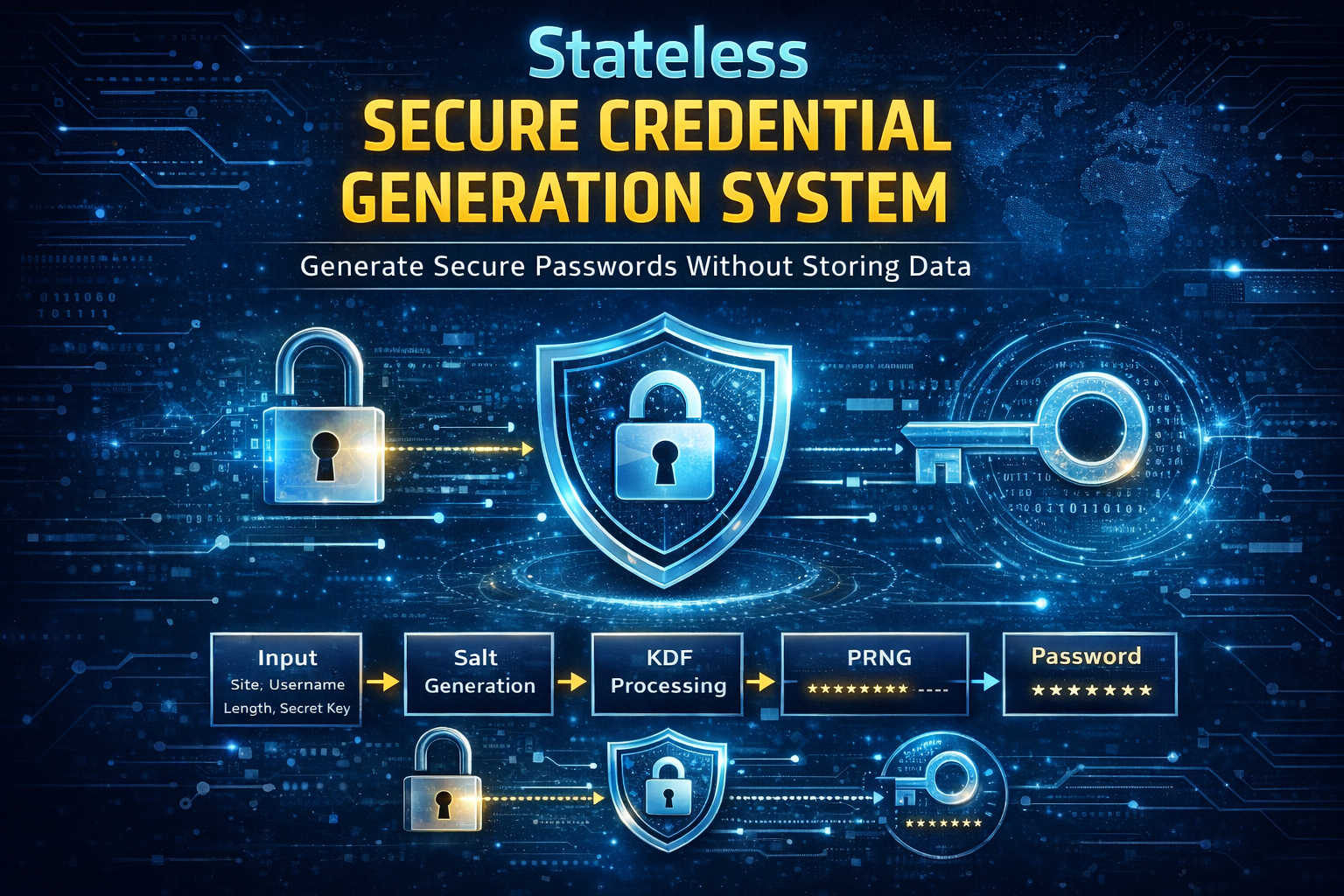
Rethinking Password Security with Privacy-First Design
🔍 Introduction
In today’s digital world, password security remains one of the most critical challenges in cybersecurity. Traditional password managers store sensitive credentials in encrypted databases, making them potential targets for cyberattacks.
While encryption adds a strong layer of protection, centralized storage still introduces risk.
To address this challenge, I developed a Stateless Password Management and Secure Credential Generation System, a privacy-focused solution that eliminates password storage entirely and instead generates secure credentials dynamically using cryptographic techniques.
🔗 Project Repository
This project demonstrates how secure credential generation can be achieved without storing sensitive information.
🧠 The Problem: Risks of Traditional Password Storage


Traditional password managers:
- Store sensitive credentials (encrypted or local)
- Depend on centralized or device-based storage
- Can be targeted by attackers
- Introduce risk of large-scale breaches
Even encrypted systems can become vulnerable if compromised.
💡 The Solution: Stateless Credential Generation


A stateless system removes the need for storing passwords entirely.
Instead of saving credentials, the system generates them dynamically using deterministic cryptographic processes.
👉 Same input = same password
👉 No storage = no database risk
⚙️ System Architecture
Input → Salt Generation → KDF Processing → PRNG → Password Output
🔍 How the System Works
1. Input Parameters
The system uses:
- Site name
- Username or email
- Password length
- Counter value
- Secret key
2. Salt Generation
A unique salt is created using input parameters to ensure password uniqueness.
3. Key Derivation Function (KDF)
A cryptographic function is applied to derive a secure seed.
Stateless password managers typically rely on KDF-based approaches to generate deterministic credentials)
4. Password Generation
A pseudo-random number generator (PRNG) produces a strong and secure password.
🔐 Key Features


- No password storage
- Privacy-first design
- Deterministic password generation
- Lightweight and efficient
- Reduced attack surface
🎯 Real-World Impact


This system improves cybersecurity by:
- Eliminating centralized password storage
- Reducing risk of credential leaks
- Enhancing privacy protection
- Supporting secure authentication practices
Stateless password systems represent a shift toward more secure and privacy-focused credential management approaches (GitHub)
⚠️ Limitations
While powerful, stateless systems have challenges:
- Users must remember input parameters
- Small changes in input produce different passwords
- Less user-friendly for non-technical users
🧠 My Contribution and Approach
This project expands on stateless security concepts by focusing on:
- Practical implementation of cryptographic credential generation
- Improving usability and accessibility
- Exploring integration with modern cybersecurity systems
Future enhancements aim to combine stateless design with intelligent systems such as:
- AI-based password recommendations
- Breach detection integration
- User-friendly interfaces
📈 Future Enhancements
- Web-based UI (Streamlit dashboard)
- AI-based password strength analysis
- Integration with breach detection APIs
- Secure local profile encryption
- Multi-platform support
🏆 Conclusion
The future of cybersecurity lies in reducing attack surfaces and minimizing sensitive data exposure.
The Stateless Password Management and Secure Credential Generation System demonstrates how eliminating password storage can significantly improve security while maintaining usability.
This approach represents a shift toward privacy-first, scalable, and intelligent security systems.
👨💻 About the Author
Muhammad Umair Shahid
Cybersecurity Professional | AI Security Researcher
- GitHub: https://github.com/mianumairusa
🙌 Final Thoughts
As cyber threats evolve, innovative approaches like stateless credential systems will play a key role in shaping the future of secure authentication.
By combining cryptography, automation, and intelligent design, we can build more resilient and secure digital ecosystems.